Magical words like witch, spell, sorcery, and curse are nearly meaningless. They’re boogeymen, slippery terms that mean different things to everyone. When someone accuses someone of putting a curse on them, it’s both a serious and absurd accusation, because it means:
- The accused has assaulted me.
- The accused has assaulted me with no weaponry other than words.
- I, the assaulted, believe that another person’s words may have altered my brain, body, and physical matter in my life.
- I, the cursed, must negate the curse with words that will act as a counterspell.
My serious and absurd accusation is that there is a curse on the modern American patriot; perhaps there is a curse on all patriots, but I can only confidently essay about the patriots I see in my country. Most patriots, I’m sure, would deny being under an evil spell, so first I must make some distinctions.
Most often, to curse means to use “foul language”, yet curses are some of the most common (and loved) words in the English language, like fuck and horseshit. Despite their popularity, people have strong opinions about these types of curses, so much so that they are called bad words.
I know plenty of conservative people who don’t use curse words; they are the same folks who believe in the “power of prayer”, yet these same people think curses (evil spells) are horseshit.
I also know liberal people who think that both prayer and curses are horseshit. Yet it is the prerogative of many liberals to change the words society uses. There is a belief that if we change a group’s noun or an individual’s pronoun, it will help heal them. They embrace curse words, but somehow their list of bad words seems to grow daily.
I’m not sure which is more useful: “praying for the homeless, or advocating for the unhoused”. They both sound cringe to me. ” Pray for the homeless” is dated and rich, like a Celine Dion lyric, and “advocating for the unhoused” sounds like someone’s OnlyFans bio. In this moment, my slight may have a more liberal-leaning reader trying to classify me in their trending nomenclature. What bad words am I? Yes, I am a white, cisgender, straight male with privilege… but I’ve also been called a libtard. This is the wickedness of language at work: we use words to label people and file them away. In conversation, no power is greater than dismissal.
We need words that can slip and slither between our increasingly binary thought politics. We need words that can act like quantum goo, inhabiting more than one position in the multiverse. Words that provoke thought, but don’t require additional education. We need to fight horseshit with horseshit. We need to fight the curse… the words we are literally trapped in, with different words.
When I use the terms wizard, witch, spell, sorcery, and curse, I use them in the most general, silly, and obtuse sense, while simultaneously using them in the most literal sense. For example:
Your grandmother was a witch. She cast a spell on you when she:
- Told you her soup would heal you.
- Assured you that the monsters under your bed wouldn’t get you.
- Reminded you that you were a good boy or girl.
Or perhaps with bad intent she told you:
- You’re fat.
- Your mother doesn’t love you.
- You’ll never find a husband.
Perhaps a stranger cast a spell on you once. In passing, they gave you a compliment that charmed you for the rest of the day. Maybe for the rest of your life. 23 years ago, while walking through the halls of my high school, eating a bag of Combos, a girl said I was “hot.” I’ve been riding that high since. Perhaps the opposite happened to you in high school. Can you remember an insult someone gave you? Did their “spell” change your mind and affect your behavior? Did you fight them? Did you cry? Did you prove them wrong? Are you still proving them wrong?
A magician is someone who uses words to change his reality; since he can change his reality with words, words make his reality. Each of us is a magician. It’s such an integral part of the human experience that The Magician is the second card in the Tarot.
The first is The Fool: the young, hopeful, full-of-life, unprogrammed youth, full of potential. The Fool is young Luke Skywalker, still living on the farm, tinkering with his uncle’s moisture vaporators. The Fool has yet to begin his journey to conquer himself and therefore the universe; the potential is there, in innocent hubris. His potential for success comes from ignorance: by trying what the experienced call impossible.
Once the Fool chooses the direction he wants to go, the reality he wants for himself, he begins to use the materials of life to provide his desired effects. When the Fool starts to get his shit together, he becomes the Magician.
It is important to remind ourselves that the Tarot was created in the 1400s; the Magician is not David Blane or Captain Kangaroo. The Magician is the chemist, the artist, the shaman, the writer, the architect, the entrepreneur, etc. The person who tries to change their reality by applying their will to matter. Magick is the ancient grandfather of religion, chemistry, psychology, even cooking.
Aleister Crowley defines Magick as “the science and art of causing change to occur in conformity with will”.
On the Magician Tarot card, all the materials of life are on the table, represented by the suits: wand, cup, sword, and disc. They represent will, emotion, thought, and physical matter.
For the rest of this program, dear reader, I mean, Magician, we will pick up the sword: the symbol of thought, language, and technology. What will we use our swords for? Shall we use them against our enemies, or turn them against ourselves? Language, like the sword, can destroy us, or liberate us. How shall we use it? First, let’s sharpen it; whether for a public beheading or our own seppuku, a sharp blade is best.
To make any change in life, you must first think it. Thoughts exist as language. In a sense, if you can’t say it, you can’t think it.
“I want a mango”
“I need to lose some weight.”
“I think I love her”
“We need to invade Iran”
To build a battleship, we need lots of steel. To make steel, you need iron and carbon. To make iron and carbon, you need the atoms of those elements. To make atoms, you need neutrons, protons, and electrons. To make those, you need even smaller particles and so on… or perhaps it is easier for the magician to simply say:
“Bring me steel.”
Thus he builds an army and wages war against his enemies. Forgive me; war is not the preferred term. I meant to say “special military operation.”
This is how spells are cast. We use words to direct materials, systems, energies, peoples, and economies.
It would be unfair and inaccurate to place your grandmother’s chicken soup spell in the same category as Trump or Putin’s. The dark and manipulative nature of the latter makes it sorcery. To me, sorcery is used to change another person’s actions against their own self-interest. There is an element of brainwashing, because a person engaged in a “special military operation” does the deeds of war without calling it such.
This is why modern spells are powerful; most of the populace is influenced by other people’s words without realizing it. Their self-image, actions, and behaviors are dictated by the words of powerful men hundreds of miles away. Presently, We’re stuck in a binary 2-party system; we’re imbeciles jumping on both ends of a seesaw, wondering why we’re not getting anywhere. Today, it’s easy to spot who is under the influence of a spell: They repeat the words that enchant them.
In 1533, Heinrich Cornelius Agrippa describes the mechanics of spellcasting: “magicians enchanting things are wont to blow and breathe upon them the words of the verse”
Who breathes the verses upon us? What are the “verses” of modern spells? Typically, they come from board-approved corporate 24-hour news cycle writing rooms or social media echo chambers. Nearly all of us have a crazy uncle or apathetic niece who parrots one of the following spells:
“Joe Biden’s economy”
“Defund the police”
“The jews control the weather”
“No ethical consumption under capitalism”
“Guns make us safer”
“Trigger warning”
My favorite trend in political spellcraft is the one that pertains to the “danger of green technology.” People who don’t ‘believe’ in climate change, who couldn’t give two fucks about Woody Woodpecker, will tell you how bad wind turbines are for birds, or how bad solar panels are for our “farmland”. Do you mean the farmland we exclusively grow corn syrup and beef feed on? The spin was particularly obvious during the 2024 presidential election, when suddenly every chauvinist I know was worried about the “sanctity of women’s sports”.
Less insidious are the spells of popular commercials. My children know the jingles and digits of several local injury attorneys. Despite never eating McDonald’s, they are “Lovin’ it.” I’m fairly certain that the only time they hear commercials is during NFL broadcasts. A league that gives even its fans CTE. Anyone in America who doesn’t watch football will tell you, most men are positively possessed August through February.
“This league!”
“These refs!”
“They gottagood quarterback”
“Listen, if they don’t start winnin’ some games…”
“Tailgates, I make a chili bean dip, first, you get the beef, then add a little corn syrup…”
If American men spent as much time talking about local politics as they do football, we’d have solved all our issues by now… but that’s not the point, is it? Patriotism is a black-and-white American flag sticker on the back of a pickup truck. A firearm collecting hobby. A finger-pointing game. Something is motivating otherwise smart, strong, and intelligent men to fear their neighbors. To collect guns. To “be prepared.”
The modern American patriot is ready to kill.
The patriot’s passion is being used against him. His social media accounts seem to be a gradual coercion to act against his own country, to take up arms, and potentially destroy his own people and institutions. He appears to be remotely manipulated through these channels. A virus-infected remote-controlled soldier. A cyborg. Human flesh with a cellular communications interface. Plugged into Russia, China, and the deranged underground bunkers of extreme nationalism. Modern-day American patriots are a standing army, not only for America, but for foreign countries as well.
The question is, who has their finger on the button?
Let’s imagine for a moment, an evil wizard wants to invade the US, what would be a better tactic?:
- Convince his own countrymen to take up arms and travel overseas to invade a country full of guns (hundreds of millions of them), using all the typical channels of politics, popularity, government, and culture, and raise funds for an expensive war.
- Secretly convince the US to spend their own money on guns (hundreds of millions of them), then use social media to convince them that their own citizens are to be feared; then, at my own convenience, plop a couple of incendiary memes on Facebook and incite a civil war.
Who is the sorcerer that is filling American men with fear? So much that they feel they need to stockpile weapons against our citizens and neighbors? We are in an arms race against each other.
Perhaps it doesn’t matter who cast the spell. The words of the spell have entered the social media flywheel. Doomsday prepping is an American pastime. Soon, homeschooling soccer moms will be teaching children about the gallows and the art of braiding slipknots for special military operations.
The accursed patriot can be easily identified by his drab attire. I can see him now: chubby but with big biceps, an obscenely large black watch, bombproof. A prewashed, faded army-green shirt with a monochrome American flag and a black rifle on it. A grey Bass Pro Shop baseball cap, torn on the brim. Jeans, ripped as if they were stolen from Toby Keith’s corpse after he fell off a motorcycle. A tactical backpack that looks like he jumped off a plane. A complexion you can only get while constipated from ketosis, nicotine pouches, and farty egg protein milkshakes. Ready to draw his weapon when he hears names like Ahmed, Jose, Ming, or Ru Paul.
I work in an area of the country perfectly primed for modern patriotic fear. The front line of American decay: Niagara Falls, NY. A vacant heap left over from our nation’s prosperous industrial era. A population of disenfranchised whites whose grandparents had better jobs than they do. A region with a peculiar lack of diversity. Even with cheap rent, Niagara Falls is not the place to pursue the American dream. It smells dead, and its people want to find the culprit. However, there is hope here. A young plant grows in the detritus. In the ash of the previous age lies the spirit of the phoenix.
The hope for resurrection shows up in a new patriotic fashion trend: faith-based streetwear. Oversized black T-shirts with conspicuously Western art:
Sculptural Roman marble bodies, dramatic gothic archangels, and baroque compositions with phrases like “for his glory” or “fear of god”.
I find this trend frightening, hopeful, and hilarious. I teach visual art to high schoolers; I love the fact that my students take an interest in Western art history and, with it, find meaning and power in its images. To embrace the study of beauty and the poetics of the master visionaries. To me, faith-based streetwear is a response to the criticism that Americans “lack culture”. For the first time in my career, I see teenagers interested in Michelangelo’s paintings.
Who would have thought that appreciation of classical art now has a tinge of rebellion?
Public school art teachers are hamstrung because much of the imagery of Western art history is religious. Our collective images of power are of half-naked saints and prophets. I am no longer catholic, nor Christian, but it is undeniable that this art has meaning. Kids want meaning. People want meaning. Most contemporary art is meaningless. Most contemporary poetry is meaningless. It is self-involved abstraction. Patriots want to be on a team. Children want to be seen.
As an American, white, cisgender, straight male with privilege, how far back in Western history do I need to go to find my heritage (without being accused of appropriation)? I feel ready to embrace the naked Greeks and Romans. The Gothic emaciated Christ. Not so much the ideas, but solid forms to hold onto, like a child who grabs onto a lamppost and spins himself around carefree.
We don’t expect the children of immigrant and indigenous families to abandon their sacred images; why do we tell ours to? Maybe we don’t have sacred images, and we need to make new ones, but it is a fool’s errand to expect the artists and curators of contemporary art to produce any for us. Most contemporary art lacks beauty and, worse, the discussion of beauty has been reduced to the bio-Marxist secretions of postmodern thought.
Natural beauty is dangerous to contemporary art because beauty’s existence proves a world rich with collective meaning. That the productions of nature have merit on their own without the nihilistic dissections of postmodernism, which ultimately is institutionalized academic Orwellian Newspeak.
How do we lift the curse on the modern patriot?
If we want to raise distinguished and cultured gentlemen, perhaps we should start by not calling them uncultured. The vacuum of purpose is being filled with today’s vacuous “fashionable” patrio-religious horseshit. Patriotism and religion are not horseshit in themselves, but what we are left with is certainly overly ruminated, uneducated cud.
Patriots need beauty. Patriots need a new wardrobe.
I propose that any man who calls himself a patriot should be forced to dress like a founding father: Capri pants, wooden shoes, a wig, and undies without an elastic waist. Furthermore, the patriots should read what the founding fathers read, learn not just their sense of duty, but their sense of beauty.
The founding fathers were critics in the noblest sense of the word. They were biophilic, and they understood that nature produced beauty effortlessly, while producing anything beautiful themselves required skill, exacting effort, and a lifetime of work.
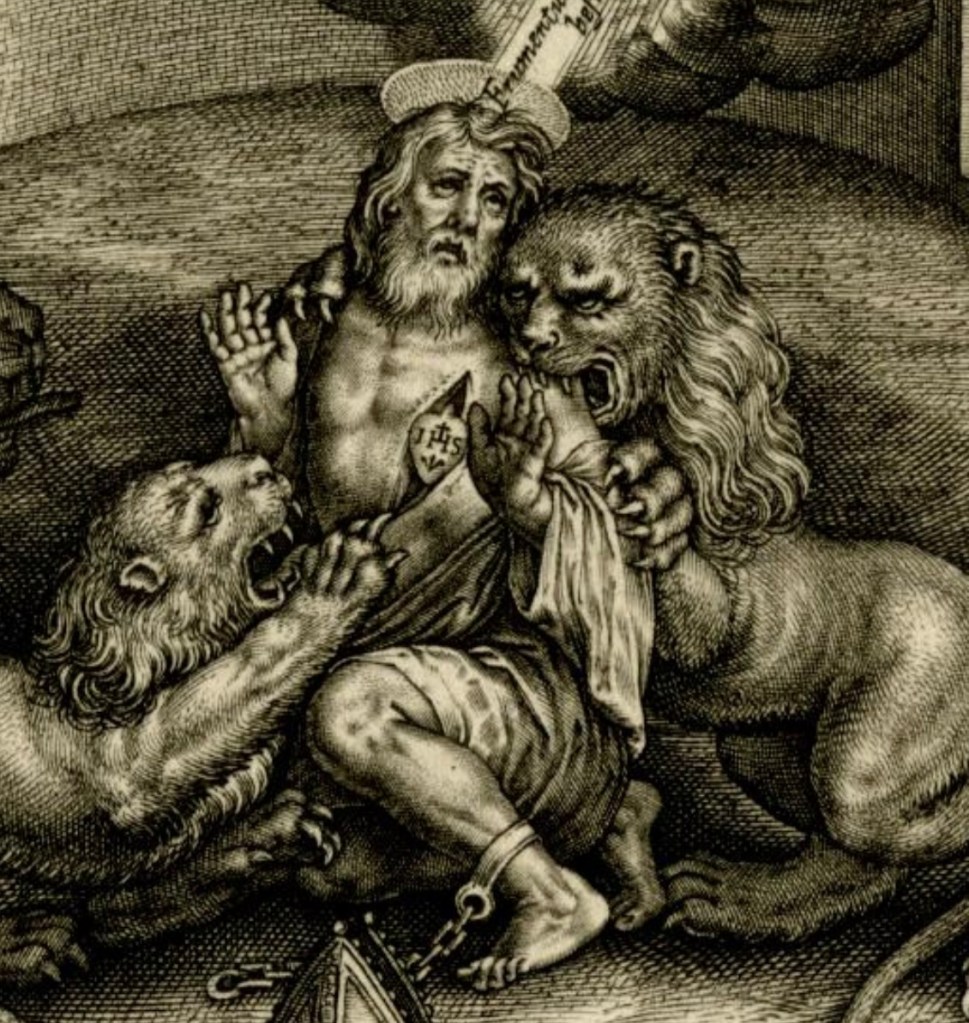
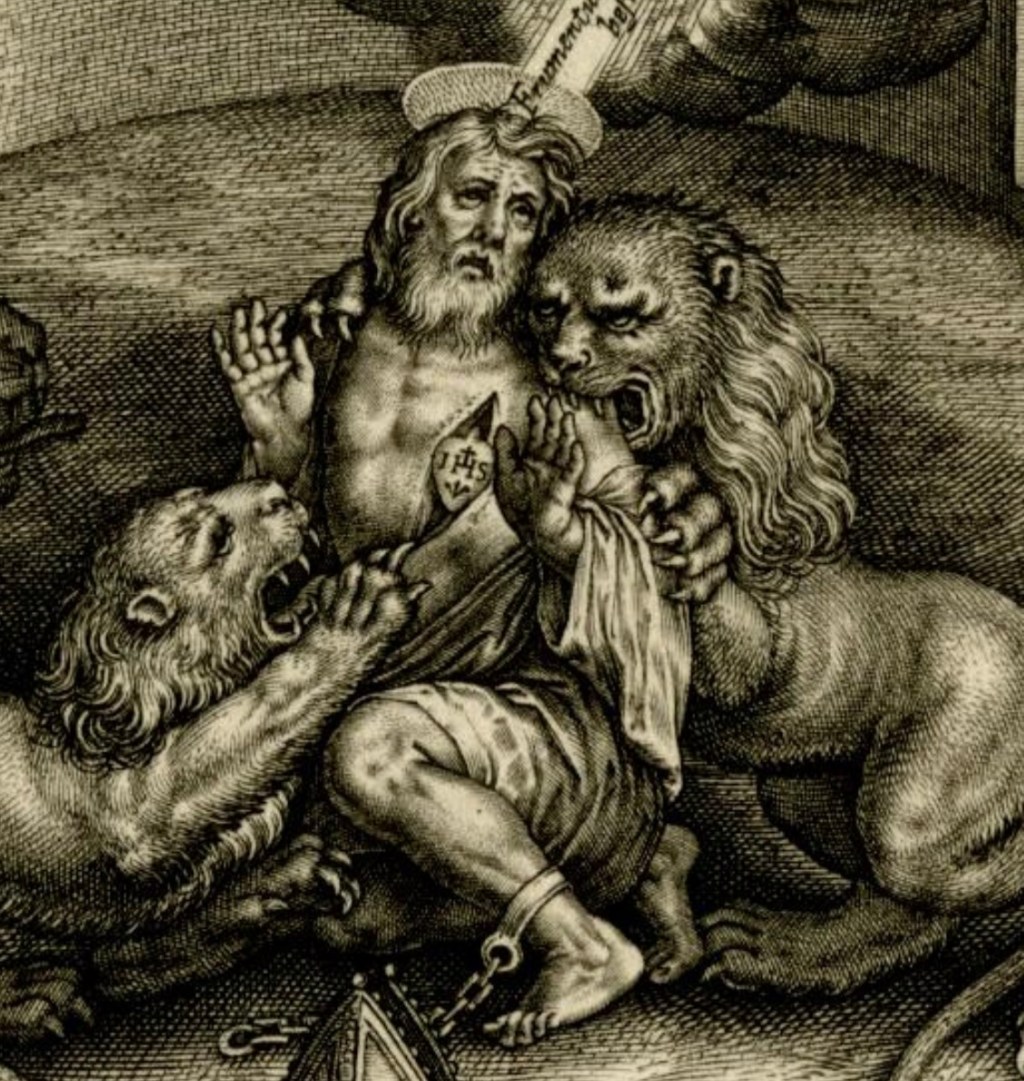
Speaking of which, nobody at Target seems to know how to make lace, so I must propose a new kind of modern patriot swag. Some Faith-based streetwear, resurrecting an old idol: Saint Ignatius of Antioch.
Ignatius was an early Christian who was torn apart by lions in the Colosseum. In 115 AD, he wrote in his letter to the Romans:
“I am God’s wheat and shall be ground by the teeth of wild animals so that I may become Christ’s pure bread.”
We will put that in bold, gold letters above an image of him being torn to pieces by beasts. It really is a perfect rebranding of Christian faith.
Christians like to say that Christ protects them from spells and curses. This magical sentiment becomes almost logical when a Christian adopts Ignatius’ attitude. How can the modern patriot be incited to violence when he’d rather die than harm a lion that’s devouring him?
If you let social media incite you to violence, then I’m sorry, Christ will be no help to you.
The early church fathers knew something trendy Christianity has forgotten: Christ is the embodiment of peace. Simple as that. When he was crucified, he looked at his accusers and said: “Forgive them, Father; they know not what they do.” He did not say, “Yo, Father, I wish I had my M-16 right now, bruh”.
Was it surrender that conquered Rome? Surrendering to the lions was an act of protest. Why? Because Christ’s death was a government-sanctioned execution. Patriots killed Christ. Christ’s teachings of nonviolence directly inspired both Gandhi and Martin Luther King Jr. Christ said, “Turn the other cheek.” Gandhi said, “You can return blow for blow if you are not brave enough to follow the path of nonviolence”.
There is an important question I don’t see fearful American patriots asking: Who benefits from a divided USA? Who benefits from a country that forgets its international neighbors and trade partners? Who benefits when Americans take up arms against each other?
Conversely, who benefits from the strength of nonviolence? The opposite of fear is not bravery; bravery requires fear to muster itself. The opposite of fear is love.
Both Christ and Lincoln said, “A house divided against itself cannot stand”. How can a prophet of peace and a commander of civil war say the same thing?
I think the woeful cries of Ignatius in the Coliseum echo to this day. Their vibrations still shake the foundations of power. The curse will be lifted when the patriot will rather be killed than kill. Then, he will no longer be a pawn, controlled by the whisperings of evil men.
Saint Ignatius was a man ahead of his time. His torn visage, perfect for the trendiest fashion.



Leave a Reply