The 12-foot skeleton from Home Depot is a new cultural icon. They are everywhere in the landscape. They crawl out of yards, throw footballs, walk dogs, and hang off roofs. Every year, Americans are spending more hard-earned cash on Halloween decorations, and not the kind we grew up with. Today, you can go to any big-box store and pick from all kinds of animatronic and inflatable horrors: a killer clown ice cream man, a rock n’ roll grim reaper, a scarecrow that decapitates itself just for a giggle. Big cats, big skulls, big ghosts, and big aliens.
I’m in my forties, I live in the neighborhood I grew up in, and I have seen Halloween grow. My kids and I call highly decorated homes “spooky houses”. As we drive through the neighborhood, they cheer and ask me to slow down as we pass. When I roll down the windows, they go silent; that’s how I know the spookiness is working.
We all have a physical reaction to fear. Halloween is an appointed time and place, our culturally approved set and setting, where we allow ourselves to fully feel fear. We stare at the brutes and carrion. The bizarre, psychotic, and absurd creations. Monsters that activate the neurological pathways of our lizard brains. The phony things somehow make us feel alive. Horror activates primal instincts. Pumps our blood, prepares us for fight or flight. Puts our minds back into our bodies and revs up our evolutionary impulses for survival.
Every year, the Halloween decor gets bigger, scarier, bloodier, and raunchier, but Halloween still isn’t the scariest holiday. Why do we love Halloween more each year? Because every year Christmas gets shittier.
Christmas has become stressful, expensive, awkward, and odd. The horrors begin a month prior. On Black Friday, people stampede and beat each other to death for flat-screen TVs and Tickle-Me-Elmos. Families go into debt to buy their children electronics, and farmers inject our turkeys with so many hormones they may as well be an inflatable Halloween decoration.
Even for the cultured, pious, and polite, Christmas is painful. The entire month of December is a drudgery of shopping, errands, and awkward work parties. Christmas songs used to be about snowflakes, warm fires, and toy soldiers. Now they are about kissing Santa with an open mouth. The smell of christmas used to be cinnamon and mulled spices; now it is the acrid factory smell that wafts up from boxes from Best Buy, bits of styrofoam clinging to our hands.
I have an idea for a horror movie: a busy dad tries to buy a gift card for his kid’s kung fu instructor, but the line at Target is so long he gradually gets entombed with walls of red shopping carts full of returned merchandise. Faced with starvation and death, he has to eat a portly and innocent teenage Target Team Member named Bryce. The entombed dad weeps for his family; Mariah Carey’s All I Want for Christmas Is You plays on the PA system as he succumbs to cannibalism.
The moral of the story? Christmas is smothering us. The 21st century, with its technology and conveniences, has not made our lives easier. We don’t have the leisure time The Jetsons promised us. We’re maximizing inefficient processes: ourselves. We’re busy buying heaps of crap for each other. Our technology is a treadmill; Google Calendar is a regime. Until we grab the reins of this mutant cyborg reindeer sleigh, it’s only going to get worse. We’re headed for a fully lubricated lighting-speed Clark W. Griswold collision. Christmas is out of control. A monster we’ve created, bent on destroying its creator.
I’m reminded of my mother. As a child, every Christmas Eve she would get sick. Ill from busting her ass for everyone. Fearful of the smallest slight, that someone in her life wouldn’t feel seen and appreciated by her. The Christmas vampire bit her, took her vitality and volition.
Christmas has its own 12-foot skeleton decor, but it’s scarier and more damaging because it remains hidden in the closet.
Many people suffer by simply sitting in a room with their family. It is difficult for many of us to be around the people who are supposed to love us. So difficult that we may fall off the wagon. Start drinking again, start using again, start doubting ourselves again. The festival of (gas)lights. For many, Christmas is not a “holy night”; it’s “holy shit, will I survive this night?”
Let’s not forget Christmas’ biggest animatronic horror. The dread patriarch, Jehovah, God the Father, waving his big cosmic finger at you for being naughty.
The inflatable animatronic Bible God comes with 3 preprogrammed phrases to scare your guests:
“Son, you have not been to church, pay your tithes, or I’ll lash your Great Aunt Susan with reeds”
“Every time you fart, you must wash your hands. It is godliness”
“My dearest daughter, when will you finally marry and breed for the sake of your bored mother?”
Religious trauma is real. Anyone who did a stint in Catholic school will tell you, at some point in their youth, they thought that they were going to hell. To be tortured by creatures far scarier than Elvira or Herman Munster. A place more terrible than any horror movie ever made. It is no secret any longer: many people have had terrible, damaging, and traumatic experiences at church.
The brighter the light, the darker the shadows.
Who is worse: a perverted priest or Michael Myers? This Halloween, I made the mistake of bringing my five-year-old into a haunted maze. She saw a zombie police officer, a giant man-eating spider, and a mutilated, lynched corpse bopped her in the forehead on the way out. She was crying. I was laughing. After a Capri Sun, she was back to normal. Dare I say that she was better off in the maze of horrors than in a church rectory?
In December of 2022, Japan made it illegal for religious institutions to use fear-based coercion on children. Threatening a kid with divine punishment is officially psychological abuse. As far as I know, there has been no change to American public policy, only popular opinion. To hell with hell. The place stinks. We don’t need it.
Furthermore, our collective image of hell is not biblical; it comes from a fantastical work of fiction, Dante’s Inferno. Hell is just a fictional horror story that got out of control. A monster let loose to engrain itself in our collective consciousness, like Frankenstein’s monster or Dracula. Stories so good, they become canon.
It is popular to claim that middle-class suburban Americans don’t have culture, but that is precisely our power; our culture is like The Blob. An amorphous, amoeba-like outer-space anomaly that engulfs everything in its path; it’s gigantic but can fit through chimneys and keyholes. It assimilates. It mimics. It has to for survival.
American culture is what we make it. Like it or not, Disney World is our Mecca. What we share is movies, sports, and TV shows. Our collective gods are not Zeus, Horus, or Apollo. They are Superman, Spider-Man, and Elsa. We know their stories, their powers, their hope. They live inside all of us as active myths.
As a kid, above my bed was an image of Luke Skywalker, pensive, holding his green lightsaber, looking out of the frame at his next threat. I didn’t know it then, but that image gave me power. Myths give us power. “Just because a story is make-believe doesn’t mean its lessons aren’t true,” said the Boy Who Cried Wolf.
In autumn, the leaves wither, turn brown, and drop. Night gets longer. The earth seems to die. Halloween is a celebration of death. Why do we celebrate it?
After someone dies, it is common to say, “they are in a better place.” The better place- who brought them there? Death.
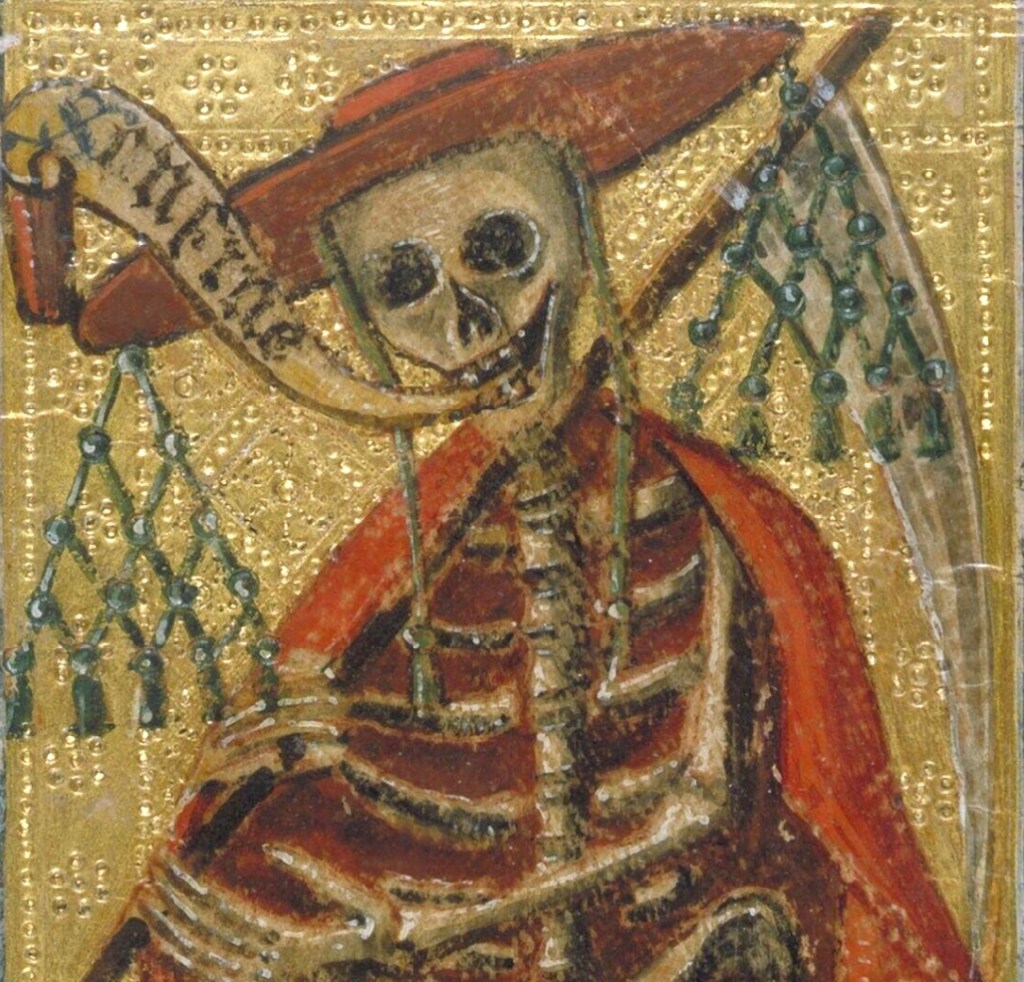
The Grim Reaper, the 12-foot skeleton with his scythe. The scythe is a tool for harvest, not a weapon. The grain has turned to seed and must be resown. This is the cycle.
On Halloween, Little boys and girls see the Grim Reaper and flip him the bird.
When we fully confront our fears, they stop nipping at our heels. “I’m not scared” is what we proudly tell our friends when faced with the horrors of Halloween. Nor should you be; death is nothing to fear. We must face our bullies, or else we’re doomed to run from them forever.
Fear of death is religious coercion.
Death is simply a turn in the maze the living can’t see beyond, a mystery that the church has stolen from you. A natural part of every living creature’s existence. Appropriated and turned into a horror story.
Why is a skeleton a powerful symbol? Because you are the skeleton. Why does your skeleton smile? Because it has passed through the door of death and realized there is nothing to fear.
Halloween still embodies the human experience of the uncanny and fear. It is something we feel in our bones.
Christmas, what feelings is this holiday supposed to embody in us? When something is embodied, something abstract (in this case, philosophical or theological) becomes visible, physical, or concrete. When we embody something, we feel the idea. We become the idea. Love, for example, is no longer something we think about; it is felt. Experienced…
In the wintertime, the earth appears to be dead. Winter was a time of starvation for our ancestors. A time of literal darkness.
Whether it is myth or reality is irrelevant; the story of christmas is simple: the tyrannical bible god decides to take on a body and be born, live, and dwell with humans. Live and suffer as a human.
God amongst us. Sitting at the dinner table. His own skeleton. Exhausted from work and his recent escape from Target. A light in the darkness. The evergreen tree in the grey and naked forest. Ambrosia.
The church would have you believe that there is only one Christ, but I say each and every one of you is Christ. You are God with skin on. An immortal light sitting at the dinner table with your own skeleton. They say, “Christ will come again”. Well, here you are. What are you waiting for?
Why is Christ so charitable? Because he knows (he sees) that every other person is God too. Therefore, every act is service. Every thought is a prayer. Every deed is worship.
Christmas is the season of giving. When we give something to someone, in the deepest and holiest sense, we give a gift to god. It’s really that simple.
What feeling is Christmas supposed to embody? Popular culture seems to have lost it. We mechaniaclly do acts of generosity, without being aware of why. That is the problem with Christmas.
Perhaps we don’t have a word for the feeling. So, I propose a new (and long) one:
The-Generous-Love-That-Creates-Peace-Beyond-Understanding.
Christmas is the recognition of the divinity of man. Lamps merging, increasing their light in chorus. We see our own divinity by seing it in others.
Church is a dusty waiting room. For 2,000 years, they’ve told us that “Christ is coming back”. For “god’s sake”, cut the line, get to the front desk, talk to the supervisor. Get to the point. God is no longer an abstract invisible entity. God is alive. A child, a beggar, a teacher, a student, etc.
Years ago, after my ego death experience, I went to a local grocery store. I could barely make eye contact with anyone because everyone in the place looked like the “Lord.” I could see that they were obviously different people in different bodies. But it was as if one immortal voice spoke through their mouths, and one seer saw through their eyes. Their individualities were not stripped away, but my judgment of them was gone. My feeling of separateness from them was gone. For the first time, I saw things quite clearly: Peace begins with the stifling of our own quarreling mind.
There is only one being; it is We.
The immortal lights. Lamps in the dark. Stars of the heavens. The Universe experiencing itself.
God with skin on.
Grinning skeletons, drinking the intoxicating wine of experience.
Art credit: 16th Century “Death” Tarot Card
If you liked this essay, please share.

Leave a Reply